Specifications
Chinese Gold Panda at a glance
Composition
- Alloy
- Gold (99.9% fine)
- Color
- Rich warm 24k gold; technically three-nines purity (not four-nines)
- Thickness
- 1.90 mm
- Available weights
- 30 g, 15 g, 8 g, 3 g, 1 g
Provenance
- Issuing mint
- People's Bank of China →
- Mint location
- Shanghai, Shenzhen & Shenyang mints
- First minted
- 1982
- Face value
- CNY 500 (30g), 200 (15g), 100 (8g), 50 (3g), 10 (1g)
- Legal tender
- Yes
- IRA eligible (US)
- Yes
Source: issuing mint specifications, cross-checked against published dealer and grading-service data.
The story
History
The Chinese Gold Panda, introduced in 1982, sits at the intersection of bullion coin and collectible in a way few other coins do.
The People's Bank of China commissioned the coin as part of China's cautious economic opening. The giant panda was an astute choice — universally recognized, uniquely Chinese, and projecting approachability. For a country establishing itself as a credible trading partner, a coin featuring China's most beloved animal sent the right message.
Like the Australian Kangaroo, the Panda changes its reverse design annually (with a few exceptions, notably 2001/2002). This annual variety has driven strong collector demand from the start, creating numismatic premiums that can significantly exceed melt value for desirable or low-mintage issues.
In 2016, the People's Bank switched the Panda from troy-ounce to metric gram denominations — a "1 oz" Panda became a "30 gram" Panda (slightly less gold). The Panda is especially treasured in China, Hong Kong, Taiwan and among ethnic Chinese communities, where gifting gold at Lunar New Year and weddings is deeply embedded.
- 1982 — First Chinese Gold Panda
- 1983– — Reverse panda design changes annually
- 2016 — Switches from troy ounces to metric grams
- A bullion/collectible hybrid prized across Greater China
The two faces
Design
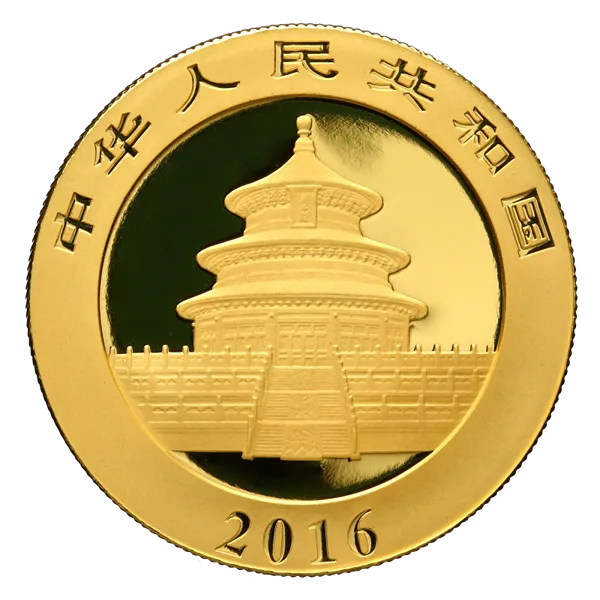
The Temple of Heaven (Tian Tan) in Beijing — one of China's most iconic landmarks, used for imperial ceremonies. "ZHONGHUA RENMIN GONGHEGUO" (People's Republic of China) and the year are inscribed.
An annually changing panda design — since 1983, each year depicts a different scene: solitary pandas, mothers with cubs, groups in bamboo forests, or close-up portraits. Early issues are particularly sought after.
Coin photography: CoinInvest GmbH (CC BY-SA 4.0); Olga Kolmykova (CC BY-SA 4.0) — via Wikimedia Commons.
Authentication & counterfeit watch
How to spot a genuine Chinese Gold Panda
Specifications depend on the era. A modern (post-2016) 30 g Panda weighs 30.00 g — slightly less than a troy ounce — at 32.00 mm diameter and 1.90 mm thick; pre-2016 "1 oz" Pandas weigh 31.10 g. Always confirm whether you're buying a 30 g or a 1 oz coin, as it changes the gold content. The Panda is non-magnetic, three-nines (99.9%) gold. Because each year's reverse is unique, verify the panda scene matches the dated year. Authentic Chinese Mint strikes show very fine frosted detail in the panda's fur; many counterfeits (the Panda is among the more faked coins) blur this. Sealed original mint packaging adds confidence for collectible issues.
Authentication guidance is general reference, not a substitute for professional verification. For high-value purchases, buy from reputable dealers and consider professional grading.
For the investor
Investment considerations
The Panda straddles investment coin and collectible more than any other major bullion coin, creating both opportunity and complexity.
IRA eligibility: at 99.9% fine the Panda meets the IRS 99.5% purity standard, so most gold-IRA custodians accept it — though a few treat it as collectible-leaning, so confirm before buying for a retirement account.
Collectible premiums: popular or scarce issues command substantial premiums over spot. Investors who understand the numismatic market can do well, but pure-bullion buyers may find Pandas more expensive than alternatives.
Metric weight change (2016): pre-2016 (1 oz / 31.1 g) and post-2016 (30 g) Pandas are technically different specifications — important when comparing prices.
Common questions
Chinese Gold Panda FAQ
Is the Gold Panda a full troy ounce?
Only the pre-2016 issues. Since 2016 the main coin is 30 grams — about 0.965 troy oz, slightly less gold than a 1 oz coin. Always check whether a Panda is "1 oz" or "30 g".
Can I put a Gold Panda in a US IRA?
Generally yes. At 99.9% fine it meets the IRS 99.5% purity minimum and is accepted by most gold-IRA custodians, though policies vary — confirm with yours.
Why do Pandas cost more than other bullion coins?
The annually changing design makes Pandas collectible, so they carry numismatic premiums above gold value — especially scarce or early issues. Pure-bullion buyers often pay less elsewhere.
Are Gold Pandas often counterfeited?
Yes — the Panda is among the more commonly faked coins. Buy from reputable dealers, prefer sealed mint packaging, and check weight, dimensions and the fineness of the fur detail.