Specifications
Swiss Vreneli (20 Francs) at a glance
Composition
- Alloy
- Gold (90%) + Copper (10%)
- Color
- Warm reddish 90% gold
- Thickness
- 1.25 mm
- Available weights
- 20 Francs, 10 Francs
Provenance
- Issuing mint
- Swissmint →
- Mint location
- Bern, Switzerland
- First minted
- 1897
- Face value
- 20 Francs (historic)
- Legal tender
- Yes
- IRA eligible (US)
- No
Source: issuing mint specifications, cross-checked against published dealer and grading-service data.
The story
History
Switzerland's 20-franc gold coin, struck from 1897 to 1949, is affectionately known as the "Vreneli" — a diminutive of Verena, after the young woman whose head graces the obverse. Like the French Napoleon, it was built to the Latin Monetary Union standard: 6.45 g, 90% gold, 0.1867 oz fine — interchangeable with the other European 20-franc coins.
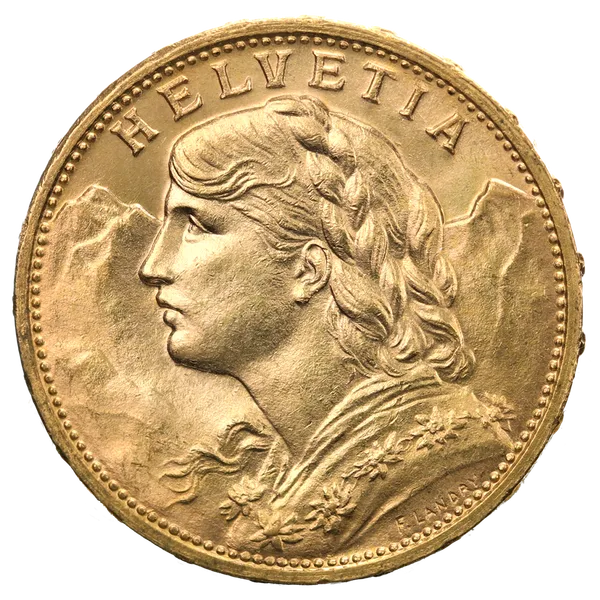
The design by Fritz Ulysse Landry depicts a young Swiss woman with braided hair against a backdrop of the Alps — a wholesome, distinctly Swiss image that made the coin a national favorite. The reverse bears the Swiss shield within an oak wreath.
Switzerland's tradition of gold saving and the coin's enormous mintage mean Vrenelis remain plentiful and inexpensive today. They are a cornerstone of the European low-premium gold market, traded freely and trusted across the continent.
- 1897–1949 — The 20-franc "Vreneli" is struck
- Built to the Latin Monetary Union standard (interchangeable with the Napoleon)
- Designed by Fritz Ulysse Landry — the young woman and the Alps
- A staple of the Swiss gold-saving tradition
The two faces
Design
The head of a young Swiss woman ("Vreneli") with braided hair, the word "HELVETIA" above and a backdrop of Alpine peaks — a warm, folkloric design beloved in Switzerland.
The Swiss shield (white cross on red) within an oak-leaf wreath, with the "20 FR." denomination and date.
Coin photography: CoinInvest GmbH (CC BY-SA 4.0); StoneX Bullion GmbH (CC BY-SA 4.0) — via Wikimedia Commons.
Authentication & counterfeit watch
How to spot a genuine Swiss Vreneli (20 Francs)
A genuine 20-franc Vreneli weighs 6.45 g, 21 mm in diameter and about 1.25 mm thick — identical bullion specs to the French Napoleon, and non-magnetic. Precise weight and diameter checks are decisive given the tight standard. Landry's portrait of "Vreneli" should show fine detail in the braided hair and the Alpine background; the Swiss cross on the reverse must be crisp. As with all dated classics, verify the date falls within the genuine 1897–1949 range and matches known issues.
Authentication guidance is general reference, not a substitute for professional verification. For high-value purchases, buy from reputable dealers and consider professional grading.
For the investor
Investment considerations
The Vreneli is the Swiss counterpart to the Napoleon: a small, abundant, low-premium gold coin perfect for accumulating gold in modest amounts. Its Latin Monetary Union specifications make it interchangeable with the Napoleon for bullion purposes.
It is not US IRA-eligible (90% fine). It remains legal tender in Switzerland and is among the most liquid coins in the European market — every Swiss and continental dealer trades them at tight spreads.
Common-date Vrenelis trade close to melt; condition matters little for most years. A handful of scarce dates command numismatic premiums, but the overwhelming majority are bought purely for their 0.1867 oz of gold.
Common questions
Swiss Vreneli (20 Francs) FAQ
What does "Vreneli" mean?
It’s an affectionate nickname — a diminutive of "Verena" — for the young Swiss woman pictured on the coin. Officially it is simply the Swiss 20-franc gold piece.
Is the Vreneli the same as a French Napoleon?
For bullion purposes, effectively yes: both are 6.45 g, 90% gold, 0.1867 oz fine under the Latin Monetary Union standard. Only the designs and countries differ.
Why are Vrenelis inexpensive?
They were minted in huge numbers and survive in quantity, so common dates trade at very low premiums over their gold content.
Is the Vreneli IRA-eligible?
No — at 90% purity it is below the IRA standard. It’s a low-cost bullion and collector coin, not an IRA coin.