Specifications
British Gold Sovereign at a glance
Composition
- Alloy
- Gold (91.67%) + Copper (8.33%)
- Color
- Warm 22k gold with the characteristic copper tone
- Thickness
- 1.52 mm
- Available weights
- Full sovereign, Half sovereign, Quarter / Double
Provenance
- Issuing mint
- The Royal Mint →
- Mint location
- Llantrisant, Wales, United Kingdom
- First minted
- 1817
- Face value
- £1 (nominal)
- Legal tender
- Yes
- IRA eligible (US)
- No
Source: issuing mint specifications, cross-checked against published dealer and grading-service data.
The story
History
The Sovereign is the most storied coin in this collection. The modern Sovereign dates to 1817, after the Great Recoinage, but the name reaches back to a gold coin of Henry VII in 1489. For a century it was the workhorse of the world's reserve currency — a coin worth one pound sterling that circulated across the British Empire and beyond.
Designed at its rebirth by Benedetto Pistrucci, the Sovereign's reverse — St George slaying the dragon — is one of the most celebrated images in all of coinage and still appears today. Sovereigns were struck not just in London but at colonial branch mints in Australia, India, Canada and South Africa, identifiable by tiny mintmarks.
The Sovereign stopped circulating as money after the First World War, but the Royal Mint has continued to strike it as a bullion and collector coin. Its small size (~0.235 oz of gold) made it, historically, the classic "sewn into the lining" emergency coin — compact, universally recognized, and easy to trade discreetly.
For modern British investors the Sovereign has a decisive advantage: as UK legal tender it is exempt from Capital Gains Tax, like the Britannia — making it one of the most tax-efficient gold holdings available in Britain.
- 1489 — First "sovereign" struck under Henry VII
- 1817 — Modern Sovereign reborn with Pistrucci’s St George
- Struck at Empire branch mints (Sydney, Melbourne, Bombay…)
- UK legal tender → exempt from Capital Gains Tax
The two faces
Design
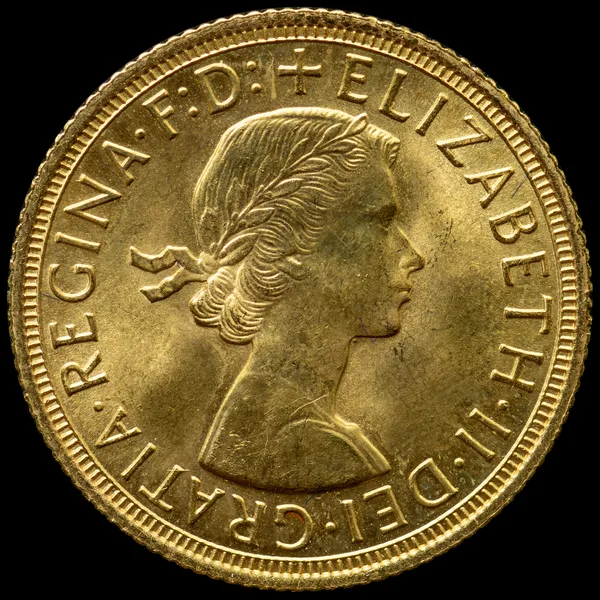
A right- or left-facing portrait of the reigning monarch (King Charles III since 2023; previously a long line back to George III). Branch-mint Sovereigns carry a small mintmark above the date or on the reverse.
Benedetto Pistrucci's classic depiction of St George on horseback slaying a dragon — first used in 1817 and one of the most admired designs in numismatic history. Some years used heraldic shield reverses instead.
Coin photography: Royal Mint & Mary Gillick (Public domain); Royal Mint & Benedetto Pistrucci (Public domain) — via Wikimedia Commons.
Authentication & counterfeit watch
How to spot a genuine British Gold Sovereign
A genuine full Sovereign weighs 7.99 g, measures 22.05 mm across and 1.52 mm thick, and contains 0.2354 oz of fine gold. It is non-magnetic. Because the Sovereign is small and heavily collected, fakes are common — but its tight, well-known specifications make a precise scale and caliper very effective: counterfeits frequently miss the 7.99 g weight or the 22.05 mm diameter. Pistrucci's St George should show crisp, fine detail in the horse's musculature and the dragon; soft or "soapy" relief is a warning sign. On dated/branch-mint examples, cross-check the monarch, date and mintmark against known issues, as fantasy date/mint combinations betray fakes.
Authentication guidance is general reference, not a substitute for professional verification. For high-value purchases, buy from reputable dealers and consider professional grading.
For the investor
Investment considerations
The Sovereign is a small, supremely liquid, internationally recognized coin — ideal for investors who want to accumulate gold in modest increments or hold easily-divisible "trading" pieces. Its long history means a deep secondary market everywhere.
For UK investors the CGT exemption is the headline: gains on Sovereigns are tax-free, a major advantage over bars or foreign coins. Combined with VAT exemption on investment gold, the Sovereign is the default tax-efficient choice in Britain.
It is not US IRA-eligible (22-karat and a fractional historic coin). Premiums on common modern bullion Sovereigns run a little higher per ounce than a 1 oz coin — expected for a small coin — while older and branch-mint Sovereigns can carry numismatic premiums.
Common questions
British Gold Sovereign FAQ
How much gold is in a Sovereign?
A full Sovereign contains 0.2354 troy oz (7.32 g) of fine gold in a 7.99 g, 22-karat coin. A half-sovereign is exactly half that.
Are Gold Sovereigns tax-free in the UK?
For UK residents, gains on Sovereigns are exempt from Capital Gains Tax (they are legal tender), and investment gold is VAT-free — making the Sovereign Britain’s most tax-efficient gold coin.
Are old Sovereigns worth more than new ones?
Common-date bullion Sovereigns trade near gold value. Scarce dates, early portraits and branch-mint issues (Sydney, Bombay, etc.) can carry significant numismatic premiums.
Is the Sovereign IRA-eligible in the US?
No — at 22 karat it falls below the 99.5% IRA purity standard. Choose a Maple Leaf, Buffalo or Eagle for a US gold IRA.