Specifications
South African Krugerrand at a glance
Composition
- Alloy
- Gold (91.67%) + Copper (8.33%)
- Color
- Deep orange-gold (copper alloy gives distinctive warm hue)
- Thickness
- 2.84 mm
- Available weights
- 1 oz, ½ oz, ¼ oz, 1/10 oz
Provenance
- Issuing mint
- South African Mint →
- Mint location
- Pretoria, South Africa
- First minted
- 1967
- Face value
- Legal tender — no fixed face value
- Legal tender
- Yes
- IRA eligible (US)
- No
Source: issuing mint specifications, cross-checked against published dealer and grading-service data.
The story
History
The Krugerrand was born from a bold strategic decision by the South African government in 1967: make gold ownership accessible to ordinary investors worldwide. Before the Krugerrand, buying gold meant dealing in bars, biscuits, or old coinage — cumbersome, expensive, and opaque.
The South African government, working with the Chamber of Mines, created a coin that contained exactly one troy ounce of fine gold, with a price that floated directly with the gold spot price. No guessing games. No confusing face values. Just gold, plus a small dealer premium. It was a revolutionary model that every subsequent bullion coin has copied.
Named after Paul Kruger — the Boer Republic president whose stern portrait graces the obverse — and "rand," South Africa's currency, the Krugerrand quickly became the world's most widely traded gold coin. By 1980, Krugerrands represented nearly 90% of the global gold coin market.
The coin's story took a dramatic turn during the apartheid era. Western nations, under political pressure, began banning Krugerrand imports throughout the 1980s. The United States banned them in 1985; the UK, Canada, and the European Community followed. South Africa's gold marketing machine was effectively shut out of its largest markets.
The sanctions ended with Nelson Mandela's release and South Africa's democratic transition. By 1994, the bans were lifted, and the Krugerrand returned to international trade. Today, with an estimated 50 million ounces minted, the Krugerrand remains the most widely held bullion coin in the world by total gold content.
- 1967 — First Krugerrand minted — the first modern bullion coin
- 1980 — ~90% of the global gold-coin market
- 1985 — US bans Krugerrand imports (apartheid sanctions)
- 1994 — Sanctions lifted; returns to world trade
The two faces
Design
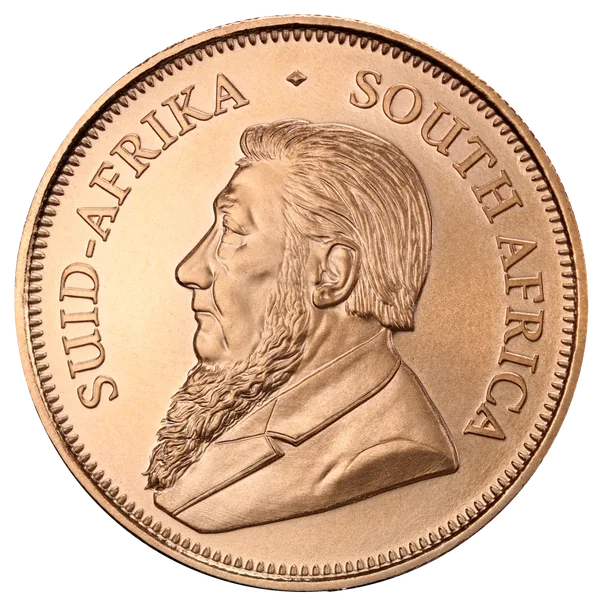
The stern, bearded portrait of Paul Kruger — president of the South African Republic (1883–1900). His image faces left, surrounded by the text "SUID-AFRIKA" and "SOUTH AFRICA" in Afrikaans and English.
A springbok antelope in mid-stride — South Africa's national animal and a symbol of agility and endurance. The coin's weight and fineness are inscribed: "KRUGERRAND 1 FYNGOUD 1 FINE GOLD."
Coin photography: Gruener Panda (CC BY-SA 4.0) — via Wikimedia Commons.
Authentication & counterfeit watch
How to spot a genuine South African Krugerrand
A genuine 1 oz Krugerrand weighs 33.93 g (it is heavier than a pure-gold 1 oz coin because of the copper alloy), measures 32.77 mm across and 2.84 mm thick. Because the alloy is non-magnetic, any attraction to a strong magnet is an immediate fail. The distinctive coppery-orange hue is itself a tell — a "Krugerrand" that looks bright yellow like a 24k coin is suspect. The reeded edge should be crisp and even; the springbok's fur and Kruger's beard should show fine, sharp detail under magnification. A calibrated scale and caliper catch the overwhelming majority of fakes, since tungsten-cored counterfeits struggle to match both the weight and the 2.84 mm thickness simultaneously. The ping (sustained ring when balanced on a fingertip and tapped) is high and clear; a dull thud suggests a base-metal core.
Authentication guidance is general reference, not a substitute for professional verification. For high-value purchases, buy from reputable dealers and consider professional grading.
For the investor
Investment considerations
The Krugerrand's 22-karat alloy (copper added for durability) means it's slightly more resistant to scratching than the soft 24-karat coins — but it also means it's not IRA eligible in the United States (which requires 99.5%+ purity for gold IRA holdings).
Globally recognized and highly liquid, Krugerrands trade in virtually every gold market on earth. Premiums over spot are typically among the lowest of any bullion coin — often 3–5% for 1 oz coins from established dealers.
Post-apartheid, the Krugerrand trades freely worldwide. Its deep secondary market means you can sell almost anywhere — a significant practical advantage for investors who plan to liquidate someday.
Common questions
South African Krugerrand FAQ
Is the Krugerrand pure gold?
No — it is 22-karat (91.67% gold, 8.33% copper). It still contains a full troy ounce of fine gold; the copper is added for durability, which makes the coin slightly heavier and gives it a warm orange tone.
Can I hold a Krugerrand in a US gold IRA?
No. The IRS requires 99.5%+ purity for IRA gold (or a specific statutory exception), and the Krugerrand’s 91.67% meets neither. The American Gold Eagle is also 91.67% but is allowed by a specific statutory exemption the Krugerrand never received. Choose a Maple Leaf, American Gold Eagle, Gold Buffalo, Britannia, Philharmonic, or Kangaroo for an IRA.
Why is the Krugerrand often the cheapest coin to buy?
Its enormous mintage and deep, liquid secondary market keep premiums among the lowest of any sovereign coin — frequently 3–5% over spot for 1 oz pieces.
Does the apartheid-era history affect its value?
No. Sanctions ended in 1994 and the coin trades freely worldwide. Value tracks gold content and a small premium, not the political history.