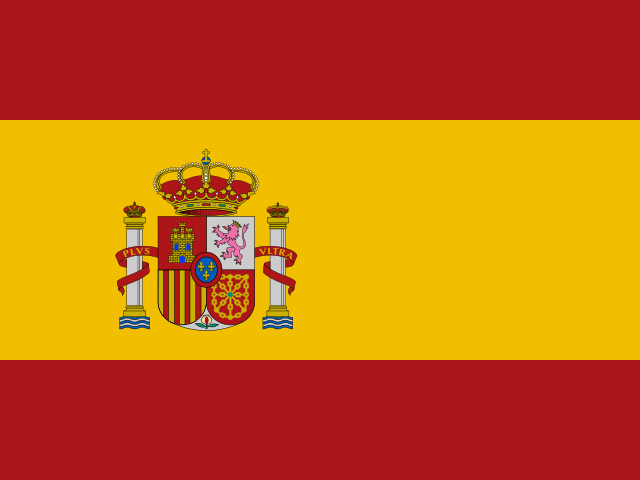
 Spain Gold Reserves
The pre-crisis sales
Spain’s modern gold history is marked by a sale it would come to regret. In 2007, the Banco de España sold roughly 80 tonnes of gold, reducing its reserve as part of the reserve management common among European central banks in that era. The timing was unfortunate in the now-familiar way: the disposal came just before the global financial crisis sent gold into one of the great bull markets of its history.
Spain was far from alone — the Banque de France, the Swiss National Bank and the Bank of England all sold gold in the years around the turn of the millennium, and all watched the price climb afterward. But the pattern is instructive. Spain’s sale, like the others, helped forge the hard lesson that European monetary authorities have since absorbed: that parting with gold for short-term reasons tends to look like a mistake in hindsight.
Held through the eurozone crisis
If 2007 was a cautionary chapter, what followed was one of restraint. When the eurozone debt crisis engulfed Spain in 2012 — forcing a bank bailout and brutal austerity — the country faced enormous fiscal pressure. Yet, like Italy and Portugal, Spain did not sell its gold to ease the strain.
The reserve held steady at around 282 tonnes through the crisis and has remained there since. The decision reflected the same conviction taking hold across southern Europe: that in a monetary union, the national gold is a backstop of credibility too important to liquidate for near-term relief. Having sold at the wrong time once, Spain was not about to do so again at a moment of acute weakness.
A moderate ratio
Gold makes up roughly 34% of Spain’s total reserves — a moderate share that sets it apart from the gold-dominated balance sheets of Italy, France or Portugal. Spain holds a more diversified mix of reserve assets, with gold an important component rather than the overwhelming one.
That moderation reflects Spain’s particular monetary history and its larger, more diversified economy. It places Spain in a middle band of European holders — substantial in absolute terms, comfortably inside the global top twenty, but without the near-total reliance on gold that characterizes some of its neighbors. The reserve is a meaningful anchor, not the entire foundation.
Spain in the European picture
Spain’s 282 tonnes form part of the vast collective European gold position — the combined holdings of the euro-area economies that, taken together, top the global table. As one of the bloc’s larger members, Spain contributes a significant share to that pooled weight, even if its own ratio is more modest than the southern European average.
In the years since the crisis, Spain’s reserve has been a model of stability: no sales, no dramatic buying, simply a steady holding maintained through calmer times. As central banks elsewhere accumulate aggressively, Spain represents the established European holder at rest — a country that made its peace with gold, learned from selling it once, and has since been content to keep what it has. For a fuller view of how the euro area’s gold fits together, see our analysis of euro-area inflation and the gold signal.
Where the gold is held
The Banco de España holds Spain’s gold, with the reserve kept partly in Madrid and partly abroad at major custodians including the Bank of England and the Federal Reserve Bank of New York, in the manner typical of the established European holders.
 Austria
  United Kingdom
  Belgium
  Portugal