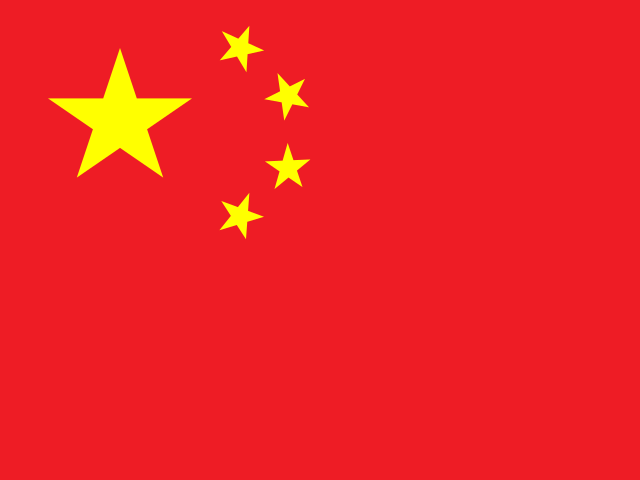
 China Gold Reserves
From 400 tonnes to the front rank
At the turn of the millennium China’s official gold reserve was a rounding error: roughly 395 tonnes, a trivial holding for an economy of its scale. What followed was one of the great accumulations in monetary history. The PBOC disclosed a jump to 1,054 tonnes in 2009, another leap to roughly 1,658 tonnes in mid-2015, and — after a long quiet stretch — resumed reporting purchases in November 2022, running an unbroken buying streak of eighteen months into 2024 before pausing and then buying again.
Today China’s reported holdings stand at 2,313.4 tonnes, the fifth-largest national reserve. But the headline figure is almost universally regarded as conservative. The PBOC has a documented pattern of accumulating quietly and disclosing retrospectively — as in 2015, when it revealed a 604-tonne increase overnight. Analysts widely believe additional state gold is held through sovereign vehicles and state banks outside the reported total.
The number beneath the number
The most revealing statistic about China’s reserve is not its size but its *share*. Gold accounts for only about 9% of China’s total reserves, against the 70–85% maintained by the United States, Germany, France and Italy. That gap is not a sign of disinterest — it is a measure of how far the rebalancing still has to run.
To lift gold to even 15% of its enormous reserves, the PBOC would need to acquire thousands of additional tonnes — on the order of two years of total global mine output. This is the structural fact that underwrites so much of the modern bull case for gold: the largest potential buyer in the world is also one of the most under-allocated, and it has signaled in deed, not just word, that it intends to keep closing the gap. Our Gold Lens analysis of the PBOC’s strategy traces why this buying is about far more than diversification.
Sanctions insurance and the dollar question
The freezing of Russia’s foreign-exchange reserves in February 2022 was a watershed for every central bank holding large dollar or euro balances. The lesson was blunt: reserves held inside another sovereign’s financial system are not truly sovereign — they can be immobilized at the stroke of a pen. For China, which holds vast dollar-denominated assets, the implication was existential.
Gold held in domestic vaults answers that risk directly. It cannot be frozen, sanctioned or confiscated by a foreign government; it is the only major reserve asset that carries no counterparty. Beijing’s onshore storage policy and its build-out of the Shanghai Gold Exchange are pieces of the same project — constructing the plumbing for a monetary system in which gold and the renminbi are intertwined, and in which China is less exposed to the financial reach of the United States. This is the same dynamic reshaping physical gold trade routes across Asia and the Middle East.
A patient, price-insensitive buyer
What makes Chinese demand so significant for the wider market is its character. Unlike speculative flows, which reverse quickly, central-bank accumulation of this kind is deliberate, patient and largely indifferent to price. The PBOC bought through the sharp rally of 2024 and kept buying at elevated levels — behavior that signals strategic intent rather than tactical positioning.
For the gold market as a whole, that creates a durable structural bid. China is the anchor tenant of a broader central-bank buying wave that has fundamentally altered gold’s supply-demand balance since 2022. It is not a sentiment-driven trade that fades when the macro narrative shifts; it is a multi-year reallocation by the world’s second-largest economy, and on the evidence of the reserve ratios, it has years left to run.
Where the gold is held
The People’s Bank of China holds its monetary gold in domestic vaults, principally in Beijing. China stores the overwhelming majority of its reserve gold onshore — a deliberate contrast to nations that keep metal in New York or London — and has built the Shanghai Gold Exchange into the world’s largest physical gold market by volume to support a renminbi-denominated bullion ecosystem.
 India
India  Japan
Japan  Uzbekistan
  Kazakhstan