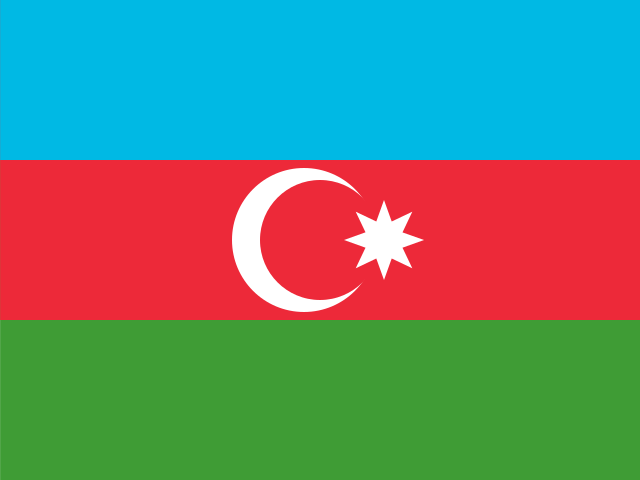
 Azerbaijan Gold Reserves
Oil turned into gold
Azerbaijan sits on substantial oil and gas wealth, exported through the pipelines that carry Caspian energy to world markets. Like other resource-rich states, it faces the perennial challenge of converting a finite, volatile income stream into lasting national wealth — and gold has become part of its answer.
The vehicle is SOFAZ, the State Oil Fund, established to capture and invest the country’s petroleum revenues for present and future generations. Among its diversified holdings, SOFAZ has built a significant gold position, accumulating the metal as a stable, tangible counterweight to the financial assets that make up the rest of its portfolio. Azerbaijan’s gold reserve is, in essence, hydrocarbons transformed into bullion.
A fund, not a central bank
What makes Azerbaijan distinctive is the custodian. In almost every other nation, official gold is held by the central bank as part of monetary reserves. In Azerbaijan, the gold belongs to the sovereign wealth fund — a structure closer to an investment portfolio than a monetary backstop.
That distinction shapes the gold’s role. As a SOFAZ holding, the metal functions as a long-horizon store of value within a diversified fund, intended to preserve the wealth generated by a depleting resource. It is less about defending a currency or anchoring monetary credibility, and more about prudent stewardship of a windfall — gold as the conservative, enduring core of a fund built to outlast the oil.
A petro-state’s prudence
Azerbaijan’s approach reflects a logic common to resource economies: diversify out of the very commodity that funds you. Holding gold gives SOFAZ an asset whose value does not move with oil prices, no foreign counterparty, and a long history of preserving purchasing power — a natural hedge for a fund whose inflows depend entirely on a single, cyclical export.
It is a quieter version of the strategic thinking visible across the energy-rich world, from the Gulf states to Central Asia. As the certainties of the petroleum age grow less certain — through energy transition, price volatility and shifting geopolitics — the appeal of holding part of the national wealth in gold, beyond the reach of any single market or government, only grows.
Gold at the Caspian crossroads
Azerbaijan’s position — at the meeting point of Europe, Russia, Iran and Central Asia — gives its reserves a geopolitical dimension as well. For a country navigating among powerful and sometimes rival neighbors, an asset that no foreign government can freeze or sanction has obvious appeal, the same security logic driving gold accumulation across the region.
The result is a modest but meaningful reserve that embodies several modern currents at once: the diversification of a petro-economy, the prudence of a sovereign fund, and the quiet strategic value of gold to a state at a crossroads of competing powers. Azerbaijan’s 200 tonnes may be held under an unusual roof, but the reasons for holding them are thoroughly of the age.
Where the gold is held
Azerbaijan’s gold is held by SOFAZ, the State Oil Fund of the Republic of Azerbaijan — the sovereign wealth fund that manages the country’s petroleum revenues — rather than by the central bank, an arrangement that sets it apart from most national holders.
 Singapore
  Thailand
  Philippines
  Kazakhstan