Specifications
Austrian Gold Ducat at a glance
Composition
- Alloy
- Gold (98.6% fine) + alloy
- Color
- Warm high-karat gold; the 4 Ducat is large and very thin
- Thickness
- 1.2 mm
- Available weights
- 1 Ducat, 4 Ducat
Provenance
- Issuing mint
- Austrian Mint (Münze Österreich) →
- Mint location
- Vienna, Austria
- First minted
- 1915
- Face value
- Historic trade coin
- Legal tender
- Yes
- IRA eligible (US)
- No
Source: issuing mint specifications, cross-checked against published dealer and grading-service data.
The story
History
The Austrian Gold Ducat is a survivor of the Habsburg trade-coin tradition. Like the silver Maria Theresa Thaler, the Vienna Mint continues to restrike the ducat to a fixed historic date — 1915 — keeping a piece of imperial Austria in continuous production.
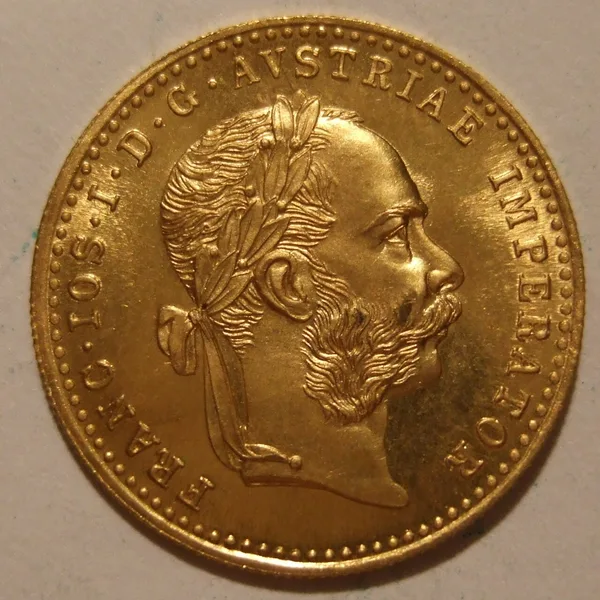
Issued as a 1 Ducat and the large, dramatically thin 4 Ducat, the coin bears the portrait of Emperor Franz Joseph I, who reigned for 68 years until 1916. Struck to the traditional ducat fineness of .986, it was for centuries a trusted unit of European commerce.
Today the restrikes are sold to collectors and investors who value the coin’s history and the Austrian Mint’s craftsmanship — a tangible link to the Austro-Hungarian Empire on the eve of its fall.
- Centuries-old ducat trade-coin standard (.986 fine)
- Restruck to a fixed 1915 date, like the Maria Theresa Thaler
- Portrait of Emperor Franz Joseph I
- Issued as 1 Ducat and the large, thin 4 Ducat
The two faces
Design
The laureate, right-facing portrait of Emperor Franz Joseph I, with a Latin imperial legend naming his titles.
The crowned double-headed imperial eagle of Austria-Hungary (1 Ducat) or a crowned heraldic design with the date 1915 (4 Ducat).
Coin photography: Jerry "Woody" from Edmonton, Canada (CC BY-SA 2.0) — via Wikimedia Commons.
Authentication & counterfeit watch
How to spot a genuine Austrian Gold Ducat
The 4 Ducat is unmistakable: about 39.5 mm across yet only ~1.2 mm thick, weighing 13.96 g at .986 fineness — a large, thin, non-magnetic coin. The 1 Ducat is small (~3.49 g). The extreme thinness for the diameter is a strong authenticity cue; the portrait of Franz Joseph and the date 1915 should be crisp. Because these are fixed-date restrikes, the 1915 date is normal and not a sign of a fake.
Authentication guidance is general reference, not a substitute for professional verification. For high-value purchases, buy from reputable dealers and consider professional grading.
For the investor
Investment considerations
The Austrian Ducat is a heritage coin: bought for its history and the appeal of a large, gleaming, thin gold piece rather than for lowest-cost bullion. The 4 Ducat packs nearly half an ounce of gold into a striking 39.5 mm coin barely a millimetre thick.
It is not US IRA-eligible (.986 falls below the 99.5% threshold). Premiums run above mass-market bullion, reflecting the coin’s niche, restrike character and craftsmanship. Liquidity is good in Europe, where the ducat is well known.
Common questions
Austrian Gold Ducat FAQ
Why are Austrian Ducats always dated 1915?
Like the Maria Theresa Thaler, the Vienna Mint restrikes the ducat to a single historic date (1915) as an official trade/heritage coin. The date does not indicate the year of striking.
How much gold is in a 4 Ducat?
About 0.4428 troy oz (13.76 g) of fine gold in a 13.96 g, .986 coin — close to half an ounce in one large, thin piece. The 1 Ducat is a quarter of that.
Is the Austrian Ducat IRA-eligible?
No — at .986 fineness it is below the 99.5% IRA standard. It is a heritage and collector coin.